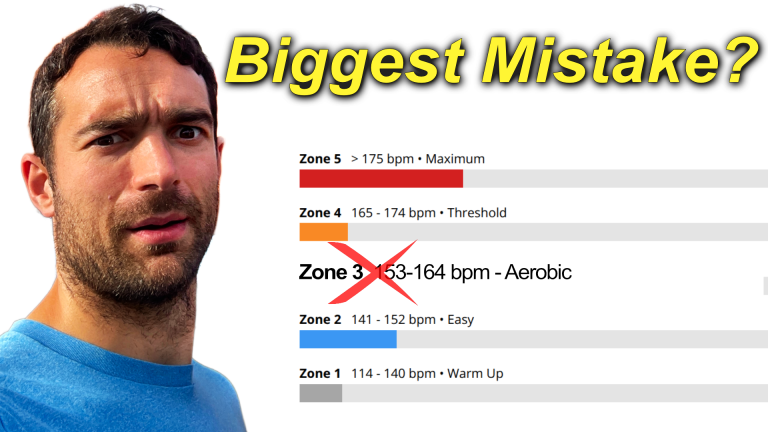
The 5-zone training model on your watch right now is probably wrong.
In fact, for most people, it is actively sabotaging your fitness by telling you a story about your body that is, at best, only half true. But… I still use it for every single one of my sessions.
The “Unproductive” Lie We’ve All Been Told
You finish what felt like a good run, look down at your watch, and it gives you the soul crushing verdict: “Unproductive”. Or maybe you have noticed that almost all of your “easy” training time is actually being logged as “Tempo” or “Threshold”.
If you have ever felt like you are constantly fighting with your heart rate zones, you are not alone. It is not your fault. The model is broken.
I have been on both sides of that battle, and it is so frustrating. Your watch gives you your “scientifically calculated” Zone 2 heart rate, and on a good day, it feels ridiculously slow. You probably thought, ‘This cannot be right,’ as you are barely moving! So, you ignore it and push into what feels like a productive effort, only to see you have spent the entire run in Zone 3.
Then, on a hot or stressful day, the opposite happens. Trying to keep your heart rate down in Zone 2 feels like a slow motion shuffle. It is demoralizing and feels completely pointless.
Either way, you are constantly second guessing your body or your watch, ending up in that horrible middle ground you probably know as the grey zone. I look back now and call it the Zone of Stupidity.
Why Your Training Zones Are Probably Wrong
The reason your zones feel wrong is because they are wrong. The default 5-zone model on your watch is built on a house of cards.
Here is the critical flaw: your device estimates your upper threshold, what we call your Lactate Threshold Heart Rate (LTHR or LT2). It might use an age formula or a guided test, but it is only looking for one of your two crucial metabolic data points.
Then, it uses a generic, one size fits all percentage to calculate all your other zones. It just assumes your aerobic threshold (the top of your easy zone) is exactly 80% of your upper threshold.
But is it? For a highly trained athlete, it might be 85% to 90%. For someone just starting, it might be as low as 70% to 75%. That generic formula does not know you. It does not know your unique physiology. You are training with seemingly personalized zones that are actually based on population averages.
You are flying blind and likely stuck in that frustrating grey zone without even knowing it.
From 5 Flawed Zones to 3 Physiological Zones
To fix this, we need to understand what is actually happening inside your body. Sports science shows that your body has two key metabolic tipping points:
- Aerobic Threshold or Lactate Threshold 1 (LT1)
- Anaerobic Threshold or Lactate Threshold 2 (LT2)
These two points create three real training zones.
- Physiological Zone 1 (Below LT1): This is your true easy, fat burning zone. You can go for hours here. This is where you build your endurance engine.
- Physiological Zone 2 (Between LT1 and LT2): This is the tempo zone for boosting your lactate buffering ability.
- Physiological Zone 3 (Above LT2): This is the hard stuff. All out intensity that triggers big gains, like boosting your VO2 max.
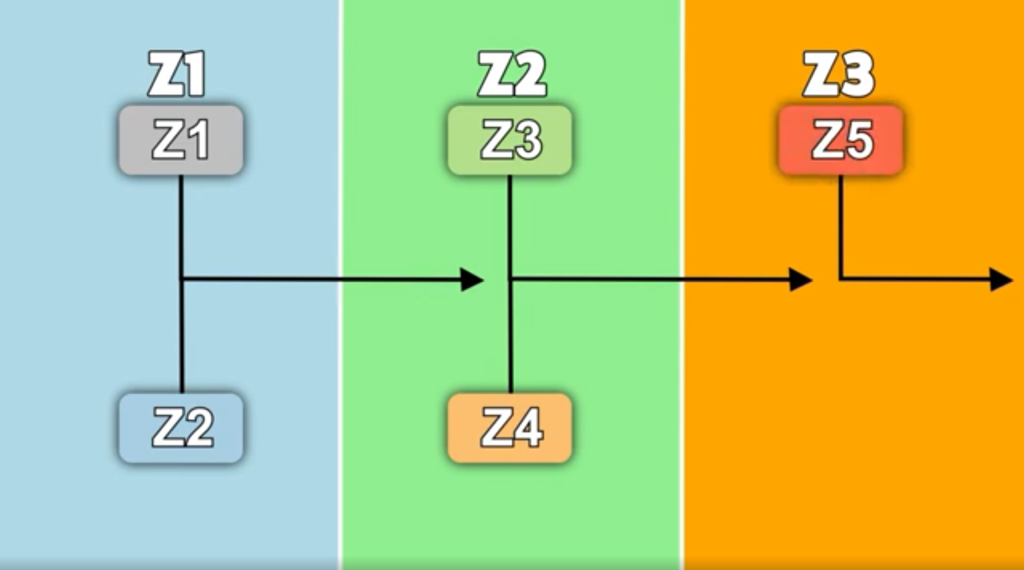
So why do our watches give us five zones? Because the terminology is common. Coaches and athletes, myself included, use them to describe target efforts. The 5-zone model can be useful, but only when it is built on a solid foundation.
Stop Guessing, Start Testing
So, how do we fix it? We stop guessing and we start testing… BOTH thresholds.
We need to anchor our zones to our actual physiology. The good news is you do not need an expensive lab test to do it. You just need a chest based heart rate monitor for accuracy.
How to Find Your LT1 (Aerobic Threshold)
The “talk test” is a surprisingly effective way to find your LT1. Your ability to speak comfortably is a great gauge for your aerobic threshold. This method works for running and cycling.
- Start exercising at a very easy pace.
- Every 4 minutes, try to say a phrase of 30 to 40 words out loud.
- If you can speak it comfortably, as you would at rest, you are below your LT1. Check your heart rate and increase the pace slightly.
- Continue this process. The highest heart rate you can hold while still speaking the full phrase comfortably is your LT1.
How to Find Your LT2 (Anaerobic Threshold)
This requires a more intense, 30 minute test.
- Warm up for 15 minutes.
- Run (or cycle) for 30 minutes at the hardest, most consistent pace you can sustain for the entire duration. Think of it like a solo 10k race.
- After the first 10 minutes, hit the lap button on your watch.
- Your average heart rate from the final 20 minutes of the test is your LTHR (LT2).
These two numbers, your LT1 and LT2, are your personal physiological fingerprint.
Building Your Personalized 5-Zone Model
Now for the magic. Once you have your two threshold heart rates, you can build a system that actually works for you.
Go into your watch or training app settings (like Garmin Connect or TrainingPeaks) and find the heart rate zones section. Instead of “Default” or “% of Max HR”, choose to set them based on “Percent of LTHR” (%LTHR).
Enter the LT2 value you just tested. Now, your zones will be calculated from a real physiological marker. You may need to manually adjust the top of your Zone 2 to match your LT1 heart rate.
Boom. They are your zones.
Your 80% easy training now perfectly maps to your new, accurate Zone 1 and 2. Your 20% hard training maps to Zone 4 and 5. And Zone 3? That becomes a true “Tempo” zone. You do not live there, but you can visit it with purpose for specific workouts.
You have transformed the flawed model into a precise, personalized tool.
This one change will revolutionize how you train. Go out, do both threshold tests, and update your settings.
What are your experiences with heart rate zones? Do you have any of your own ways of testing these thresholds? Drop them in the comments below. I would love to hear from you.
Now go train smarter and be efficient.